
Bitcoin, Forex Trading, and the Insurance of Ships and Aircraft in Europe: Modern Markets in a Changing Financial Landscape
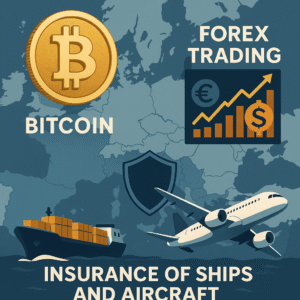
In recent years, Europe has become a center of innovation and regulation for several major global industries, including cryptocurrencies, foreign exchange markets, and transport insurance. Although Bitcoin, Forex trading, and the insurance of ships and aircraft appear unrelated at first glance, they share common themes of digital transformation, risk management, and strict regulatory frameworks. Together, they reflect how Europe balances innovation with financial stability.
Bitcoin in Europe
Bitcoin has grown rapidly across Europe, driven by a combination of technological curiosity, investment opportunities, and the desire for alternative financial systems. Several European countries, including Germany, Switzerland, and the Netherlands, have emerged as leading hubs for cryptocurrency adoption. They offer supportive legal environments, blockchain research centers, and a high level of public interest.
A major milestone for Europe was the introduction of the Markets in Crypto-Assets (MiCA) regulation, which represents the world’s first comprehensive legal framework for digital assets. MiCA aims to create clarity for businesses, protect consumers, and reduce risks such as fraud and market manipulation. As a result, cryptocurrency exchanges and fintech companies have begun offering regulated Bitcoin services, including custody, trading, and payment solutions.
Bitcoin’s popularity in Europe is supported by several use cases: international transfers, online payments, investment portfolios, and participation in decentralized finance. As European banks explore integrating blockchain technologies, Bitcoin is slowly becoming part of the mainstream financial ecosystem.
Forex Trading in Europe
Europe is one of the largest and most important regions for Forex (foreign exchange) trading, with London traditionally serving as the world’s top Forex center. Even after the United Kingdom’s exit from the European Union, London, Frankfurt, and Zurich continue to dominate global currency markets.
Forex trading in Europe benefits from a highly regulated environment. Institutions such as the Financial Conduct Authority (FCA) in the UK, CySEC in Cyprus, and BaFin in Germany enforce strict rules to protect traders and ensure market integrity. These rules include limitations on leverage, requirements for client fund protection, and standardized risk warnings. The European Securities and Markets Authority (ESMA) also plays a major role in shaping Forex policies across the continent.
Europe’s leadership in the Forex industry is attributed to several factors: access to major liquidity providers, advanced technology, stable financial institutions, and a long history of global trade. Both institutional investors and retail traders engage heavily in Forex to manage currency exposure, hedge risks, or take advantage of price movements.
Insurance of Ships and Aircraft in Europe
Europe’s strategic geography, strong maritime history, and major aviation hubs make it a global leader in transport insurance, particularly for ships and aircraft. The continent hosts some of the world’s most important insurance markets, with Lloyd’s of London being one of the oldest and most influential institutions for marine and aviation coverage.
Marine Insurance
Europe handles a significant percentage of global shipping traffic. Marine insurance covers a wide range of risks, including:
-
hull and machinery damage
-
cargo loss
-
collisions and navigation hazards
-
pollution and environmental liability
Ports such as Rotterdam, Hamburg, and Antwerp rely heavily on insurance to support safe and efficient maritime operations.
Aviation Insurance
European aviation insurance is equally robust. It protects airlines, private pilots, and aircraft leasing companies against risks such as:
-
aircraft hull damage
-
passenger liability
-
technical failures
-
unexpected weather events
-
war and terrorism risks
With major airports like Heathrow, Frankfurt, and Schiphol, Europe requires sophisticated insurance systems to ensure global aviation safety.
Technological Innovation
Europe’s transport insurance industry is rapidly adopting new technologies such as satellite tracking, predictive weather analytics, artificial intelligence, and real-time monitoring of vessels and aircraft. These tools help insurers assess risks more accurately and respond quickly to potential hazards.
Conclusion
Bitcoin, Forex markets, and the insurance of ships and aircraft show Europe’s dynamic approach to financial and economic development. Through strong regulation, advanced technology, and global leadership, Europe has positioned itself at the forefront of modern financial innovation while ensuring safety and stability across multiple industries.
